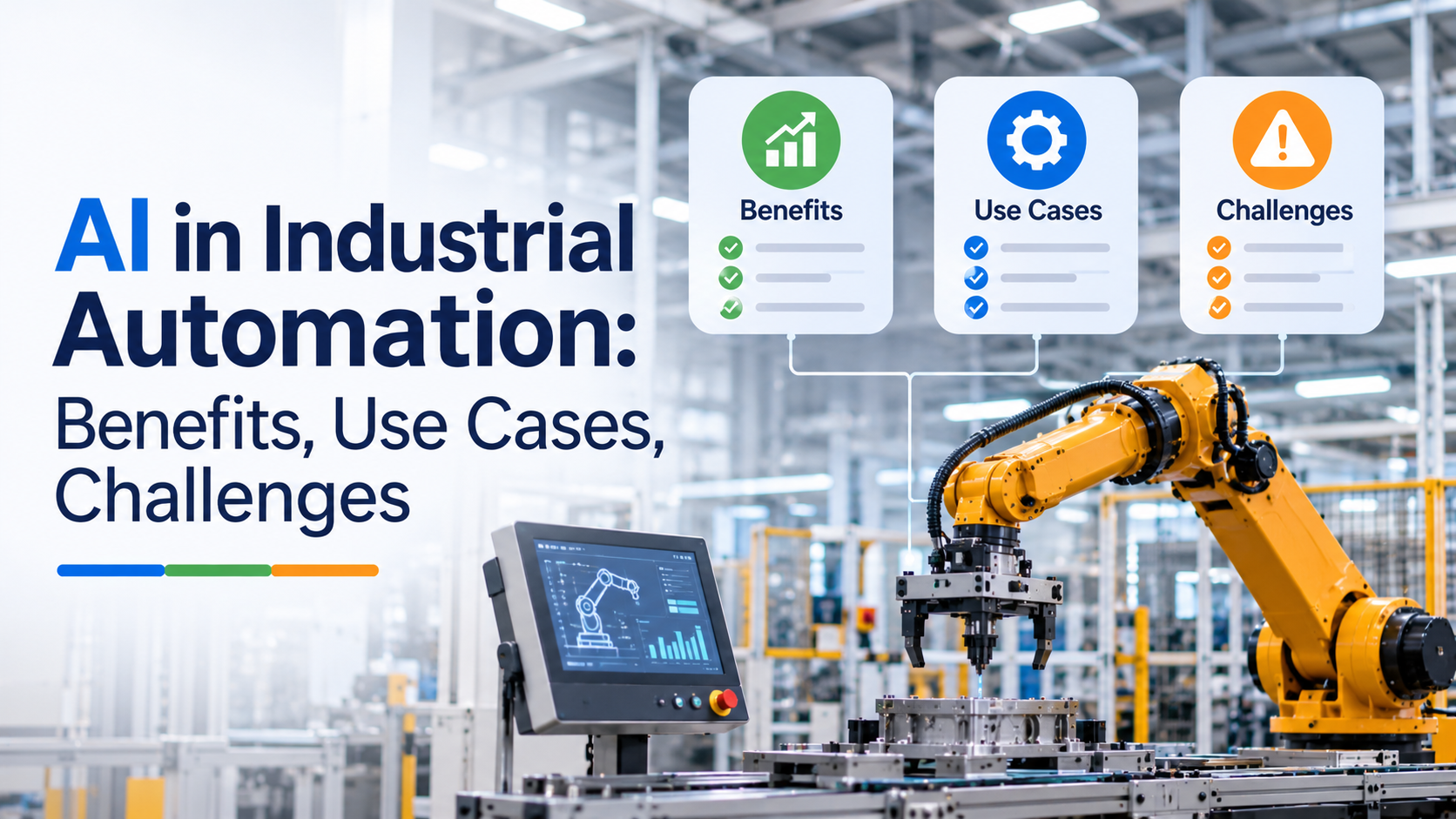

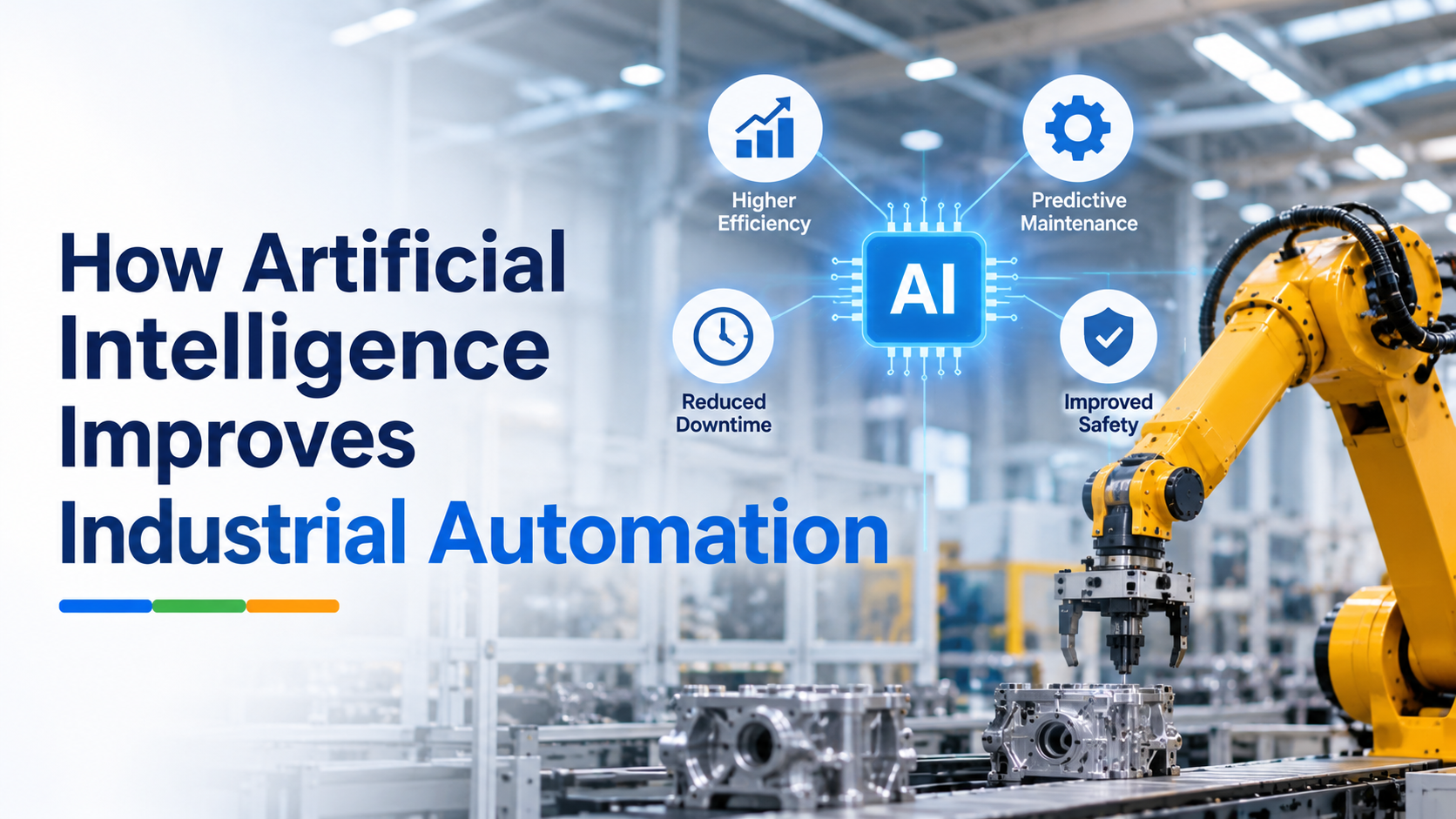
How Artificial Intelligence Improves Industrial Automation
Factories, warehouses, energy plants, and processing facilities have used automation for decades. Programmable logic controllers (PLCs), sensors, and robots have long handled repetitive tasks with speed and consistency. But traditional automation follows fixed rules: it does exactly what it was programmed to do, and it struggles when conditions change. This is where artificial intelligence changes the picture. This guide explains how artificial intelligence improves industrial automation, where it delivers the most value, what challenges to expect, and how to start.
What Is Industrial Automation?
Industrial automation is the use of control systems, machines, software, and sensors to operate industrial processes with minimal human intervention. Typical building blocks include:
Sensors and instruments that measure temperature, pressure, vibration, flow, position, and more
Controllers such as PLCs and distributed control systems (DCS)
Supervisory systems such as SCADA and human-machine interfaces (HMI)
Manufacturing execution systems (MES) and enterprise software
Actuators, drives, and robots that carry out physical actions
Traditional automation is excellent at repeatable, well-defined tasks. It is less suited to complex, variable situations where the best action depends on many changing factors.
What Does AI Add to Automation?
Artificial intelligence, especially machine learning, allows systems to learn patterns from data rather than relying only on fixed rules. In industrial settings, AI can:
Detect patterns humans and rule-based systems miss
Predict equipment failures, demand, and quality problems before they happen
Optimize settings and schedules across many variables at once
Interpret images, sound, and text such as camera feeds, machine noise, and maintenance logs
Adapt to changing conditions and improve as more data is collected
In short, traditional automation executes. AI helps systems sense, decide, and improve.
Traditional Automation vs AI-Enabled Automation
Aspect | Traditional Automation | AI-Enabled Automation |
|---|---|---|
Decision logic | Fixed, rule-based | Learns from data, adapts |
Maintenance | Scheduled or after failure | Predictive, based on condition |
Quality control | Sampling or fixed thresholds | Continuous, image- and data-driven inspection |
Handling variation | Limited | Better at managing variable inputs |
Optimization | Manual tuning by experts | Continuous, multi-variable optimization |
Robots | Pre-programmed paths | Vision-guided, more flexible behavior |
Data use | Mostly for control and records | Used to predict, recommend, and improve |
Key Ways AI Improves Industrial Automation
1. Predictive Maintenance
Unplanned downtime is costly. AI analyzes sensor data such as vibration, temperature, current, and acoustic signals to spot early signs of wear or failure. Instead of replacing parts on a fixed schedule or after a breakdown, maintenance teams can act when the data shows a real need. This reduces surprise stoppages, extends equipment life, and helps plan spare parts and labor.
2. Automated Quality Inspection
Computer vision models can inspect products on the line, detecting surface defects, assembly errors, missing parts, and labeling problems. Unlike manual sampling, AI-based inspection can check every item at production speed and produce consistent results. Over time, the data also helps trace defects back to their root causes.
3. Process Optimization
Many industrial processes involve numerous interacting variables, such as temperature, pressure, speed, and raw material properties. AI can find combinations that improve yield, reduce waste, and cut energy use, and it can adjust recommendations as conditions change.
4. Smarter, More Flexible Robotics
Vision and learning allow robots to handle objects that vary in shape, position, or orientation. Tasks like bin picking, sorting, and flexible assembly become more practical. Collaborative robots (cobots) can work safely alongside people and be redeployed to new tasks more easily.
5. Demand Forecasting and Production Planning
AI can analyze sales history, seasonality, and market signals to forecast demand more accurately, helping plants plan production, manage inventory, and reduce both shortages and overstock.
6. Supply Chain and Logistics Optimization
In warehouses and logistics, AI supports route planning, inventory placement, automated picking, and delivery scheduling, helping reduce delays and handling costs.
7. Energy Management
Energy is a major operating cost. AI can identify inefficient equipment behavior, optimize loads, and schedule energy-intensive tasks to reduce consumption and, where applicable, emissions.
8. Safety and Compliance Monitoring
AI-enabled cameras and sensors can help detect safety risks such as missing protective equipment, unsafe proximity to machinery, or hazardous conditions, alerting supervisors faster. These tools support, but do not replace, safety systems and procedures.
9. Anomaly Detection and Process Monitoring
AI can learn what normal operation looks like and flag unusual patterns in real time, helping operators catch problems that fixed alarms may miss.
10. Digital Twins and Simulation
A digital twin is a virtual model of a machine, line, or plant. Combined with AI, it allows teams to test changes, predict outcomes, and train staff without risking live production.
11. Scheduling and Resource Allocation
AI can create and adjust production schedules based on orders, machine availability, material supply, and changeover times, responding faster to disruptions.
12. Knowledge Support for Operators
Natural language tools can help workers search manuals, maintenance records, and procedures, and summarize shift reports, reducing time spent finding information.
How AI Fits Into an Automation System
Typical Technology Stack
Sensors and IIoT devices for collecting data
Edge computing for low-latency processing close to machines
Connectivity and protocols such as OPC UA and MQTT to move data between systems
Data storage and pipelines to clean, label, and organize data
Machine learning platforms for training and deploying models
Integration with PLC, SCADA, MES, and ERP systems so AI insights lead to action
Dashboards and alerts for operators, engineers, and managers
Cybersecurity controls to protect networks and data
Where AI Is Used Across Industries
Industry | Common AI Applications |
|---|---|
Manufacturing | Quality inspection, predictive maintenance, production planning |
Automotive | Vision-guided assembly, defect detection, supplier forecasting |
Food and beverage | Sorting, packaging inspection, process consistency, shelf-life prediction |
Pharmaceuticals | Batch monitoring, quality analytics, compliance support |
Energy and utilities | Grid forecasting, equipment monitoring, load optimization |
Oil, gas, and mining | Asset health monitoring, safety monitoring, process optimization |
Logistics and warehousing | Automated picking, routing, inventory optimization |
Electronics | Microscopic defect detection, yield analysis |
Benefits of AI in Industrial Automation
Less unplanned downtime through earlier warnings
Higher and more consistent quality with continuous inspection
Lower waste and energy use through optimization
Improved productivity and throughput from better scheduling and process control
Safer workplaces with better monitoring and early alerts
Faster decisions based on data rather than guesswork
Greater flexibility to handle product variety and changing demand
Knowledge retention as expertise is captured in data and models
The size of these benefits depends on your processes, data quality, and implementation, so measure results in pilots rather than assuming a fixed return.
Challenges and How to Handle Them
Challenge | Why It Matters | Practical Approach |
|---|---|---|
Poor or missing data | Models are only as good as their data | Audit sensors, fix data gaps, and standardize collection |
Legacy equipment | Older machines may lack connectivity | Add retrofit sensors and gateways |
Integration complexity | AI must work with PLCs, SCADA, and MES | Use standard protocols and phased integration |
Cybersecurity | More connectivity increases exposure | Segment networks, control access, and monitor continuously |
Skills gap | Teams may lack data and AI expertise | Train staff and partner with experienced providers |
Unclear ROI | Projects without goals stall | Start with a specific, measurable use case |
Trust and explainability | Operators need to understand recommendations | Use transparent models and clear explanations |
Safety and compliance | Industrial settings have strict rules | Keep safety-critical functions certified and human-supervised |
Model drift | Conditions change over time | Monitor performance and retrain regularly |
How to Get Started: A Practical Roadmap
Define a clear problem. Choose a use case with measurable impact, such as reducing downtime on a critical machine or cutting defects on one line.
Assess your data. Identify what you collect, how reliable it is, and what is missing.
Start small with a pilot. Pick one line, machine, or process to prove value.
Involve operators and engineers early. Their knowledge improves models and builds trust.
Build the data and integration foundation. Connect sensors, storage, and control systems securely.
Develop, test, and validate models. Compare predictions with real outcomes before relying on them.
Keep humans in the loop. Begin with recommendations and alerts before moving to automatic actions.
Measure results. Track metrics against a baseline.
Scale gradually. Expand to similar machines and lines once the pilot succeeds.
Maintain and improve. Monitor models, retrain them, and update processes.
Metrics to Track
Overall equipment effectiveness (OEE)
Unplanned downtime and mean time between failures
Defect rate, scrap, and rework
First-pass yield
Energy consumption per unit produced
Maintenance costs
Throughput and cycle time
Safety incidents and near misses
Best Practices
Start with problems that matter to the business, not with technology for its own sake.
Invest in data quality before advanced models.
Combine domain expertise with data science.
Keep safety-critical systems separate and certified.
Document models, data sources, and decision rules.
Plan for ongoing maintenance of models, not just initial deployment.
Secure the full chain from sensors to cloud.
What Is Next for AI in Industrial Automation?
Expect continued growth in edge AI that runs on or near machines, more use of digital twins, AI-assisted programming and maintenance tools, and more flexible robots that learn new tasks quickly. Generative AI is also starting to assist engineers with documentation, troubleshooting, and code. As these tools mature, success will depend on data quality, integration, cybersecurity, and workforce skills as much as on the algorithms themselves.
Frequently Asked Questions
How does artificial intelligence improve industrial automation? It adds learning and prediction to automated systems, enabling predictive maintenance, automated inspection, process optimization, flexible robotics, and faster, data-driven decisions.
Does AI replace PLCs and SCADA systems? No. AI typically works alongside them. Control systems execute reliable real-time control, while AI provides analysis, prediction, and recommendations.
Will AI replace factory workers? AI changes tasks more than it removes the need for people. Repetitive inspection and monitoring may be automated, while demand grows for roles in maintenance, data, supervision, and process improvement.
What is the best first AI project in a factory? Predictive maintenance for a critical machine or automated visual inspection on one line are common starting points because they have clear, measurable outcomes.
Do I need new machines to use AI? Not always. Many older machines can be monitored with retrofit sensors and gateways.
How much data do I need? It depends on the use case. Quality matters more than quantity, and some applications work with modest datasets while others need large amounts of labeled data.
Is AI safe to use in industrial environments? It can be, when safety-critical functions remain under certified control systems, humans supervise key decisions, and systems are tested and monitored carefully.
The Bottom Line
Artificial intelligence improves industrial automation by helping machines and processes sense what is happening, predict what is coming, and adapt to change. From predictive maintenance and quality inspection to energy savings and flexible robots, AI builds on existing automation rather than replacing it. Start with a focused problem, invest in data and integration, keep people involved, and scale what works. Done well, AI turns automated factories into smarter, safer, and more efficient operations.