
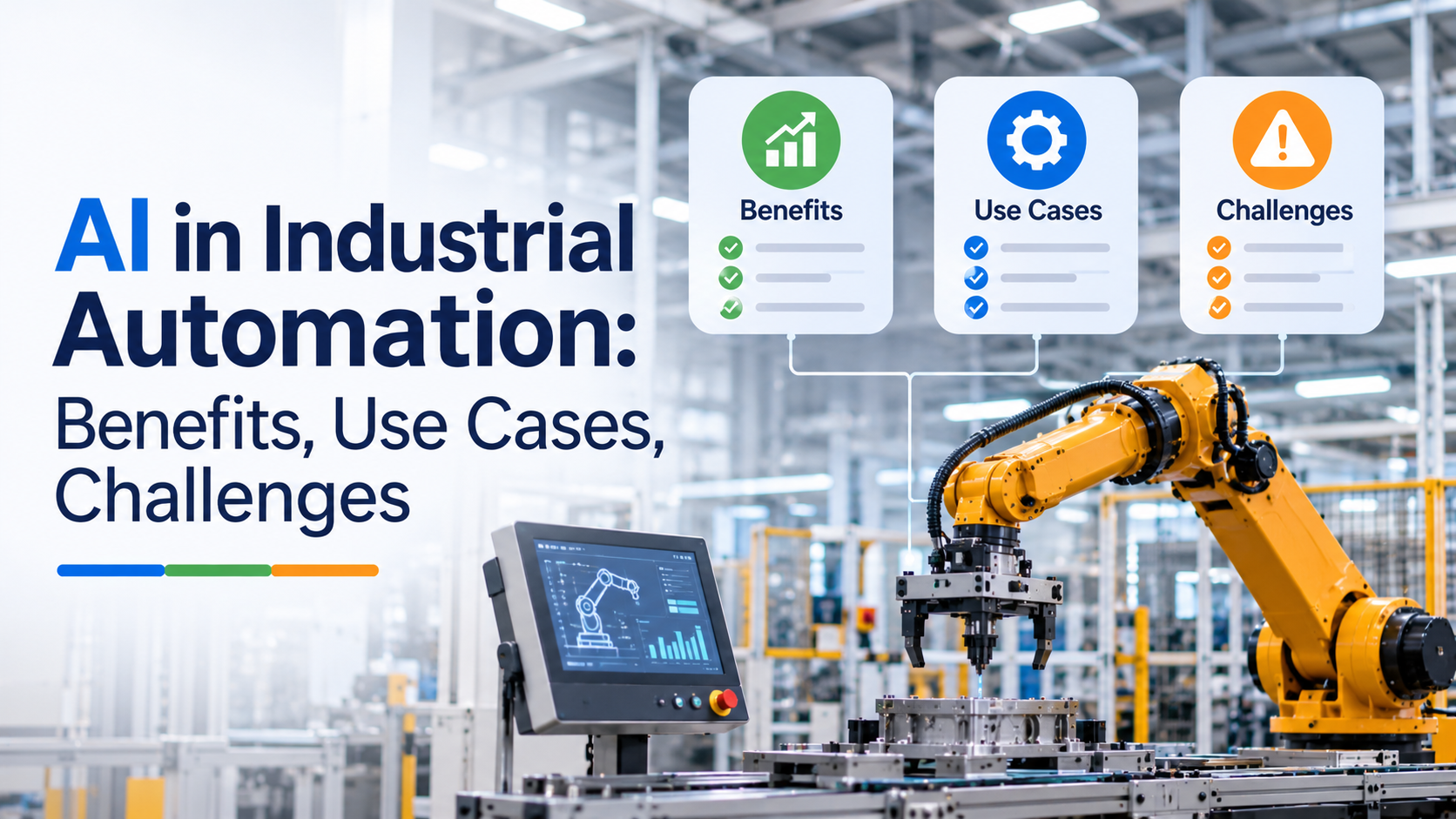
AI in Industrial Automation: Benefits, Use Cases, Challenges
Industrial companies are under pressure from every direction: tighter margins, skilled-labor shortages, shorter product cycles, stricter quality and sustainability expectations, and supply chains that can change overnight. Automation has helped for decades, but fixed-rule systems can only go so far. AI in industrial automation adds the ability to learn from data, predict problems, and adapt to change. It also brings real costs, risks, and organizational demands. This guide gives a balanced view: the benefits worth pursuing, the use cases that tend to work, the challenges that derail projects, and a practical way to decide where to start.
Key Takeaways
AI builds on existing automation (PLCs, SCADA, MES, robots) rather than replacing it.
The strongest early use cases usually involve equipment health, visual inspection, and process optimization.
Benefits depend heavily on data quality, integration, and how well the solution fits real operations.
The biggest obstacles are rarely algorithms. They are data, legacy systems, cybersecurity, skills, and change management.
Start with a narrow, measurable problem, prove value in a pilot, then scale.
What Do We Mean by AI in Industrial Automation?
In this context, AI refers mainly to machine learning, computer vision, optimization, and increasingly language models applied to industrial operations. These tools analyze data from sensors, machines, cameras, and enterprise systems to predict outcomes, recommend actions, or adjust processes. Traditional control systems still run the real-time loops that keep machines safe and stable. AI sits alongside them, adding insight and adaptability.
The Benefits of AI in Industrial Automation
Operational Benefits
Less unplanned downtime. Models trained on vibration, temperature, current, and other signals can flag deteriorating equipment earlier than fixed alarms, giving maintenance teams time to plan repairs instead of reacting to breakdowns.
More consistent quality. Vision systems and process analytics can inspect every unit and spot subtle drift before it turns into scrap, which helps maintain stable output across shifts and sites.
Higher throughput and better equipment use. Smarter scheduling and process tuning help plants run closer to their real capacity, reducing idle time, bottlenecks, and changeover losses.
Greater flexibility. Vision-guided robots and adaptive systems handle product variety and small batches better than rigidly programmed machines.
Financial Benefits
Lower maintenance and scrap costs. Fewer emergency repairs, better spare-parts planning, and fewer defects reduce avoidable spending.
Reduced energy use. Optimization of loads, set points, and schedules can cut consumption in energy-intensive processes.
Better working capital. More accurate demand forecasts and production plans can reduce excess inventory and stockouts.
Workforce and Safety Benefits
Safer environments. AI-supported monitoring can help detect hazards, unsafe behavior, and abnormal conditions sooner. These tools complement, and do not replace, certified safety systems and procedures.
Less repetitive work. Automating routine inspection and monitoring lets skilled employees focus on analysis, improvement, and problem-solving.
Preserved know-how. Models and structured data capture patterns that experienced operators recognize intuitively, helping transfer knowledge to new staff.
Strategic Benefits
Faster, evidence-based decisions. Managers see trends and risks earlier and can act on data rather than assumptions.
Resilience. Better forecasting, monitoring, and scheduling make it easier to respond to disruptions.
Sustainability progress. Less waste and lower energy use support emissions and resource targets.
How to Measure Each Benefit
Benefit | Example Metrics |
|---|---|
Less downtime | Unplanned downtime hours, mean time between failures, mean time to repair |
Better quality | Defect rate, scrap, rework, first-pass yield, customer returns |
Higher throughput | Overall equipment effectiveness (OEE), cycle time, units per shift |
Lower costs | Maintenance cost per asset, cost per unit produced |
Energy savings | Energy per unit produced, peak demand |
Safety | Incidents, near misses, response time to alerts |
Forecasting | Forecast error, inventory turns, stockout rate |
Always record a baseline before the pilot so you can compare results honestly.
Use Cases of AI in Industrial Automation
Equipment Health and Reliability
Predictive maintenance for motors, pumps, compressors, and rotating equipment
Remaining useful life estimation to plan replacements
Anomaly detection to catch unusual behavior early
Root-cause analysis support by connecting failures with operating conditions
Quality and Inspection
Visual defect detection on surfaces, welds, packaging, and assemblies
Dimensional and assembly verification using cameras and sensors
Process-based quality prediction that estimates quality from process data before final inspection
Production and Process Optimization
Parameter optimization to improve yield and reduce waste
Dynamic scheduling that adapts to orders, delays, and machine availability
Batch and recipe optimization in chemicals, food, and pharmaceuticals
Robotics and Material Handling
Vision-guided picking and sorting
Collaborative robots that share space with workers
Autonomous mobile robots for moving materials in plants and warehouses
Supply Chain and Logistics
Demand forecasting and production planning
Inventory optimization across sites and warehouses
Route and load planning for internal and external logistics
Energy and Sustainability
Load forecasting and optimization
Detection of energy waste in compressed air, heating, and cooling systems
Emissions monitoring and reporting support
Safety and Compliance
Personal protective equipment detection and restricted-zone monitoring
Hazard and leak detection using sensors and cameras
Automated record keeping to support audits
Engineering and Operations Support
Digital twins for simulating changes before applying them
Assistants that search manuals, logs, and procedures
Drafting reports and shift summaries for human review
Illustrative Scenarios
These examples are hypothetical and show how use cases play out. Real results depend on your plant and data.
Packaging line: cameras check labels and seals on every item. When a pattern of faulty seals appears, the system alerts the team and correlates it with a specific sealing temperature drift, allowing a quick fix.
Pump station: vibration and current data feed a model that flags a bearing showing early signs of wear. Maintenance is scheduled during planned downtime rather than after a failure.
Food plant: an optimization model suggests small adjustments to oven temperature and belt speed for different product batches, reducing both overcooked waste and energy use.
Warehouse: forecasting and picking optimization reduce travel time for pickers and cut mispicks during seasonal peaks.
Choosing Which Use Case to Start With
Not every use case is worth doing first. Score each candidate on value and feasibility.
Factor | Questions to Ask |
|---|---|
Business value | How costly is the problem today? Is it frequent or severe? |
Data readiness | Do we already collect relevant data? Is it accurate and labeled? |
Technical feasibility | Is the problem well defined and measurable? |
Integration effort | How hard is it to connect to existing systems? |
Risk | Could mistakes affect safety, compliance, or customers? |
Ownership | Is there a sponsor and a team who will use the results? |
Building the Business Case
A credible business case compares costs and benefits honestly.
Cost items to include
Sensors, gateways, and connectivity hardware
Software licenses, cloud, and compute
Data engineering and integration work
Model development and validation
Cybersecurity measures
Training and change management
Ongoing monitoring, retraining, and support
Benefit items to include
Avoided downtime and repair costs
Reduced scrap, rework, and returns
Energy and material savings
Productivity gains
Safety improvements and reduced incident costs
Use conservative assumptions, include ongoing costs, and define success criteria before the pilot starts.
The Challenges of AI in Industrial Automation
1. Data Quality and Availability
Sensors may be missing, miscalibrated, or poorly labeled, and data may sit in silos. Models trained on bad data produce bad results. Approach: audit data sources, standardize formats, and fix collection gaps before building models.
2. Legacy Equipment and Systems
Older machines may lack connectivity or use proprietary protocols. Approach: use retrofit sensors, gateways, and standard protocols, and integrate in phases.
3. Integration with OT and IT Systems
AI must connect to PLCs, SCADA, MES, ERP, and maintenance systems to turn insight into action. Approach: define clear data flows, use open standards where possible, and involve both operations and IT teams.
4. Cybersecurity
More connectivity widens the attack surface, and operational technology networks have different requirements from office IT. Approach: segment networks, control access, monitor activity, and apply recognized industrial security practices.
5. Safety and Regulatory Requirements
Industrial settings are governed by strict safety and compliance rules. Approach: keep safety-critical functions on certified systems, validate AI behavior thoroughly, and keep humans responsible for key decisions.
6. Skills and Culture
Teams may lack data science experience, and operators may distrust unfamiliar tools. Approach: train staff, involve operators from the start, explain recommendations clearly, and show early wins.
7. Model Drift and Maintenance
Equipment, materials, and conditions change, so models can lose accuracy. Approach: monitor performance, retrain on new data, and assign clear ownership for model maintenance.
8. Explainability and Trust
Operators need to understand why a system recommends an action. Approach: use interpretable outputs, show supporting evidence, and let users give feedback.
9. Cost and ROI Uncertainty
Projects can stall if costs grow or benefits are unclear. Approach: start with a limited pilot, track results against a baseline, and scale only after proving value.
10. Vendor Lock-In and Scalability
Proprietary platforms can make it hard to switch or expand. Approach: prefer open standards, clear data ownership terms, and architectures that can grow.
11. Unrealistic Expectations
AI is not magic, and early results may be modest. Approach: set clear, achievable goals and communicate what AI can and cannot do.
Governance and Risk Checklist
Who owns each AI system and its performance?
What data is used, and who is allowed to access it?
How are models validated before deployment?
What happens if the model is wrong or unavailable?
Which decisions are automatic and which require human approval?
How are changes to models tracked and documented?
How is the system secured from sensors to cloud?
How are incidents investigated and learned from?
Build, Buy, or Partner?
Option | Strengths | Watch-Outs |
|---|---|---|
Build in-house | Full control and customization | Needs strong data and engineering skills and long-term maintenance |
Buy a ready-made solution | Faster to deploy, proven for common use cases | May not fit unique processes, risk of lock-in |
Partner with specialists | Access to expertise and faster learning | Need clear scope, knowledge transfer, and data ownership terms |
Many companies combine approaches, buying proven tools for standard problems and building custom models where they have a competitive edge.
A Phased Implementation Approach
Discover (weeks 1 to 4): identify problems, review data, and select a pilot use case.
Prepare (weeks 4 to 10): fix data gaps, connect systems, and set baselines and success criteria.
Pilot (weeks 10 to 20): develop, test, and validate the solution on one line or asset group, with humans reviewing outputs.
Evaluate: compare results with the baseline and decide whether to scale, adjust, or stop.
Scale: extend to similar assets and sites with standardized data pipelines and support processes.
Operate and improve: monitor models, retrain, and add new use cases.
Timelines vary widely by organization and use case, so treat these ranges as a rough guide.
Common Mistakes to Avoid
Starting with technology instead of a business problem
Skipping data preparation and expecting models to cope
Running pilots without a baseline or success criteria
Excluding operators and maintenance teams from design
Letting AI make safety-critical decisions without proper safeguards
Ignoring cybersecurity until after deployment
Treating deployment as the finish line instead of the start of maintenance
What to Watch Next
Edge AI that runs close to machines, wider use of digital twins, AI-assisted engineering tools, and language-model assistants for operators and technicians are all growing areas. As they mature, companies that have invested in clean data, solid integration, and skilled teams will adopt them most successfully.
Frequently Asked Questions
What are the main benefits of AI in industrial automation? Less unplanned downtime, more consistent quality, better use of equipment, lower energy and waste, safer operations, and faster, data-driven decisions.
What are the most common use cases? Predictive maintenance, visual quality inspection, process optimization, demand forecasting, robotics, energy management, and safety monitoring.
What are the biggest challenges? Data quality, legacy systems, integration, cybersecurity, skills, safety and regulatory requirements, and keeping models accurate over time.
How do I choose the first project? Pick a problem with clear business value, available data, manageable risk, and a team ready to use the results.
Does AI replace human workers in factories? It automates some repetitive tasks, but people remain essential for supervision, maintenance, improvement, and judgment. Roles often shift toward data and process skills.
How long does it take to see results? It depends on the use case and data readiness. A focused pilot can show early results in a few months, while scaling takes longer.
Is AI in industrial automation expensive? Costs vary widely. Starting small, using existing data, and focusing on high-value problems helps control spending.
The Bottom Line
AI in industrial automation offers meaningful benefits, from fewer breakdowns and better quality to lower waste and safer operations. But results depend on strong data, careful integration, robust security, and engaged people. Choose use cases by value and feasibility, build a realistic business case, pilot with clear baselines, and keep humans in control of critical decisions. Companies that approach AI as a disciplined operational improvement, not a one-off technology purchase, are the ones most likely to see lasting returns.