
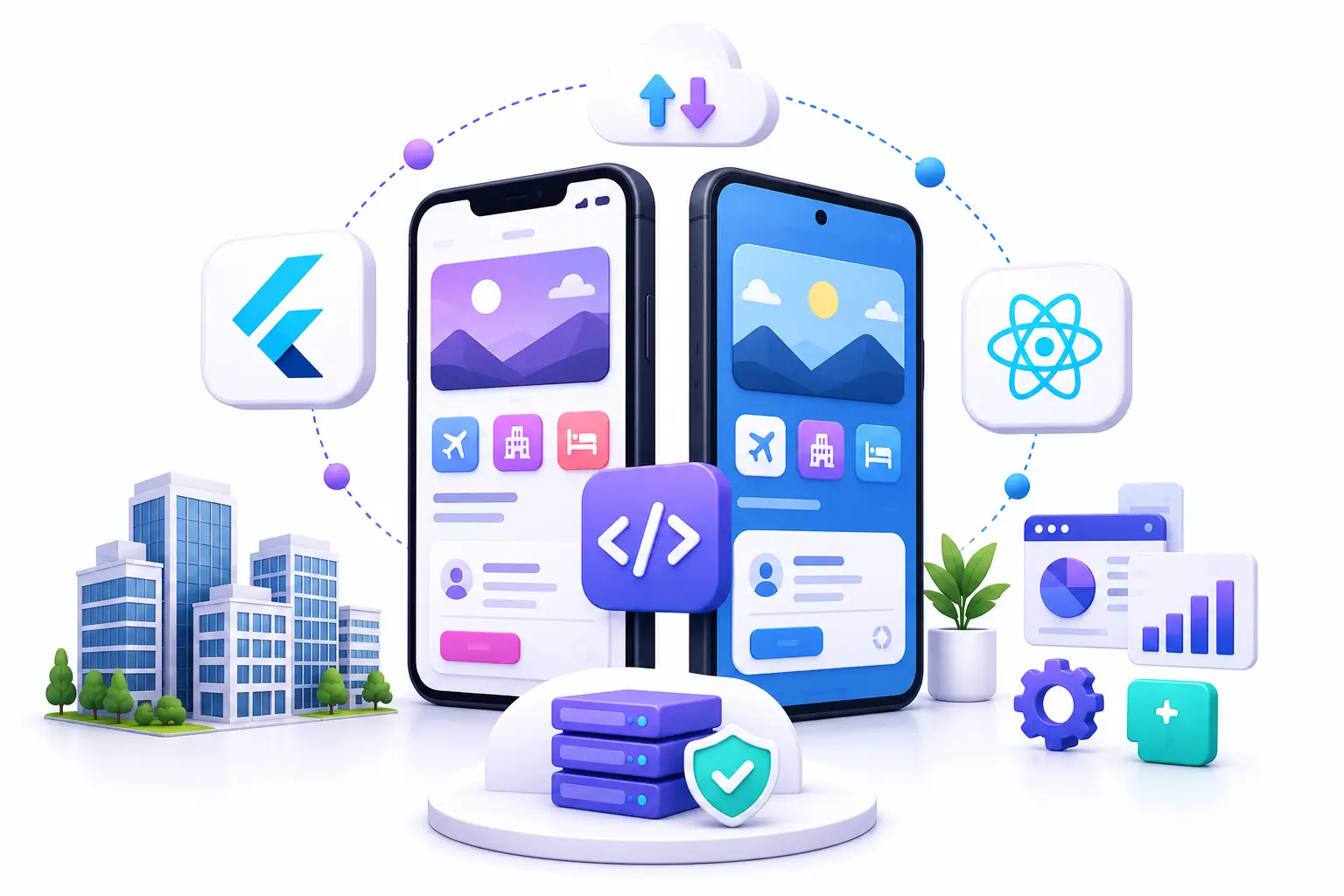
Teenva AI and Digital Ventures builds cross-platform mobile applications from Bangalore, India, using Flutter and React Native. A single codebase ships to both iOS and Android, which typically means faster MVPs and lower long-term maintenance compared to running two separate native teams.
We design and build travel booking apps, SaaS mobile clients, ecommerce apps, and B2B field tools, backed by our in-house API development, mobile app design, and systems integration teams. For most business applications, we recommend a cross-platform approach until there is a proven, specific reason to go native — typically once product-market fit is established and performance or platform requirements demand it.
Get your mobile app built
Flutter & React Native — one codebase, two app stores, faster launch.
What Is Cross-Platform Development?
Cross-platform mobile development uses a shared codebase that runs on both iOS and Android, instead of writing and maintaining two separate native applications.
| Framework | Language | Maintained By |
|---|---|---|
| Flutter | Dart | |
| React Native | JavaScript / TypeScript | Meta and open-source community |
Both frameworks use platform-specific channels to access native device capabilities — camera, push notifications, and store APIs — when needed. In most business applications, the vast majority of the UI and logic can be shared across platforms.
Flutter vs. React Native
| Dimension | Flutter | React Native |
|---|---|---|
| UI | Custom rendering engine for consistent, pixel-accurate design | Renders through native components via a bridge to the platform |
| Performance | Strong for custom UI and animation-heavy screens | Strong, with continued improvements from the New Architecture |
| Team Fit | Requires learning Dart | A natural fit if your team already works in React or Next.js |
| Ecosystem | Growing package ecosystem with increasing enterprise adoption | Mature, large npm ecosystem with broad community support |
| Best Suited For | Greenfield MVPs and design-heavy products | Products that share code or a design system with an existing React web app |
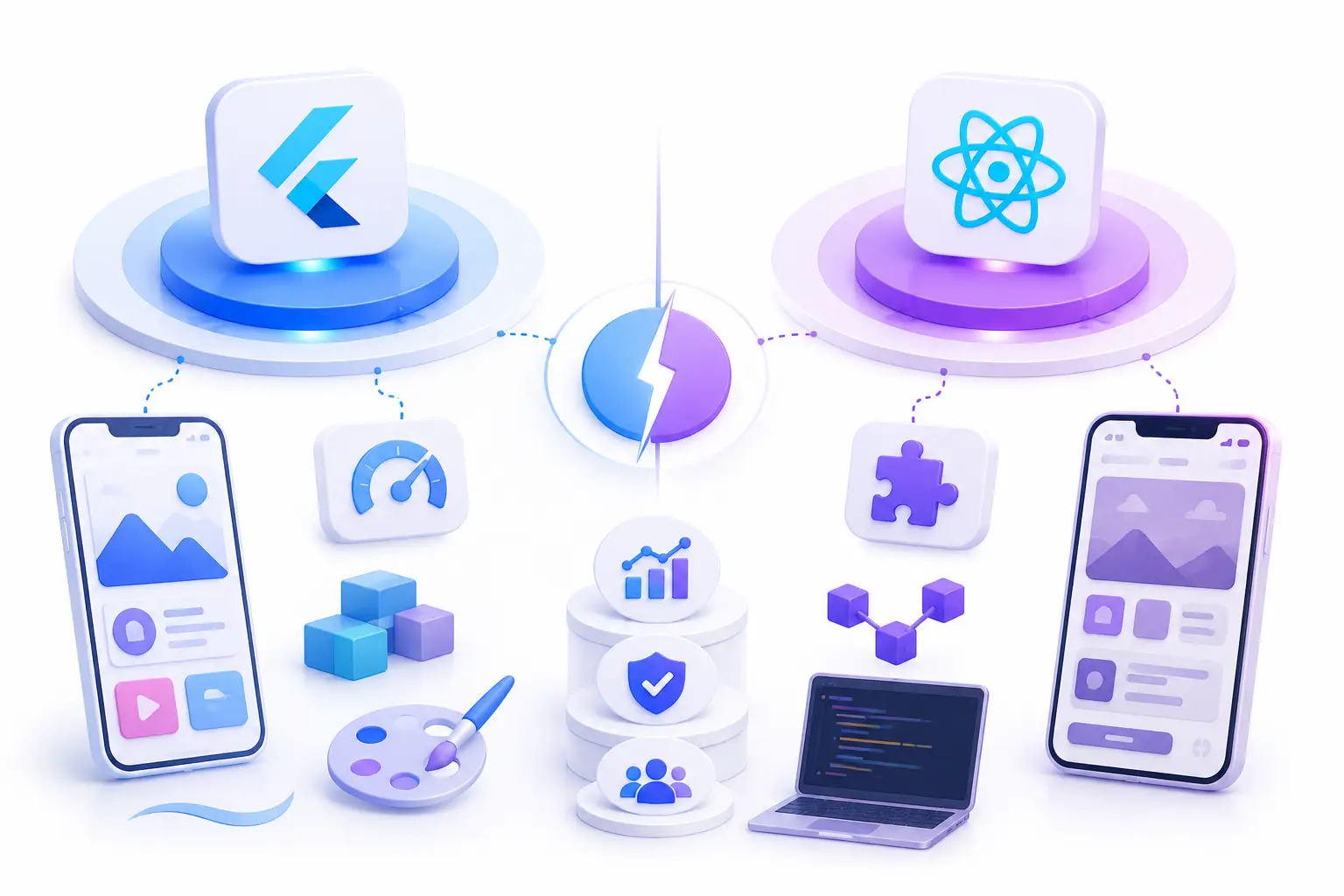
We don't default to one framework for every project — the right choice depends on your team's existing skills, your product's design requirements, and what we learn during discovery. Both frameworks are production-proven for travel and SaaS applications — including with Next.js web products.
Cross-Platform vs. Native
| Cross-Platform (This Service) | Native Swift / Kotlin |
|---|---|
| One codebase for both app stores | Highest achievable performance and deepest access to platform SDKs |
| Faster MVP delivery, lower initial cost | Higher cost, since iOS and Android are built and maintained separately |
| Well suited to forms, lists, and booking flows | Better suited to AR, complex games, and platform-specific UI |
Our honest recommendation: start with cross-platform unless discovery surfaces a specific reason not to — such as heavy use of platform-specific hardware, AR/VR requirements, or performance needs that only native development can meet. Learn about native mobile app development.
Apps We Build with Flutter / React Native
| Type | Examples |
|---|---|
| Travel & OTA | Search, booking, payments, PNR management, e-vouchers |
| SaaS Mobile | Companion apps for an existing SaaS web product |
| Ecommerce | Product catalog, cart, checkout with Razorpay/UPI |
| B2B / Agency | Agent login, custom pricing/markup, bookings placed on behalf of clients |
| Field Operations | Data collection forms, photo capture, GPS check-in |
| AI-Powered Apps | Conversational interfaces connected to your backend APIs |
Who We Build Cross-Platform Apps For
- Travel & OTA companies
- SaaS businesses needing a mobile client
- Ecommerce brands
- B2B agencies and marketplaces
- Field operations teams
- Startups building an MVP
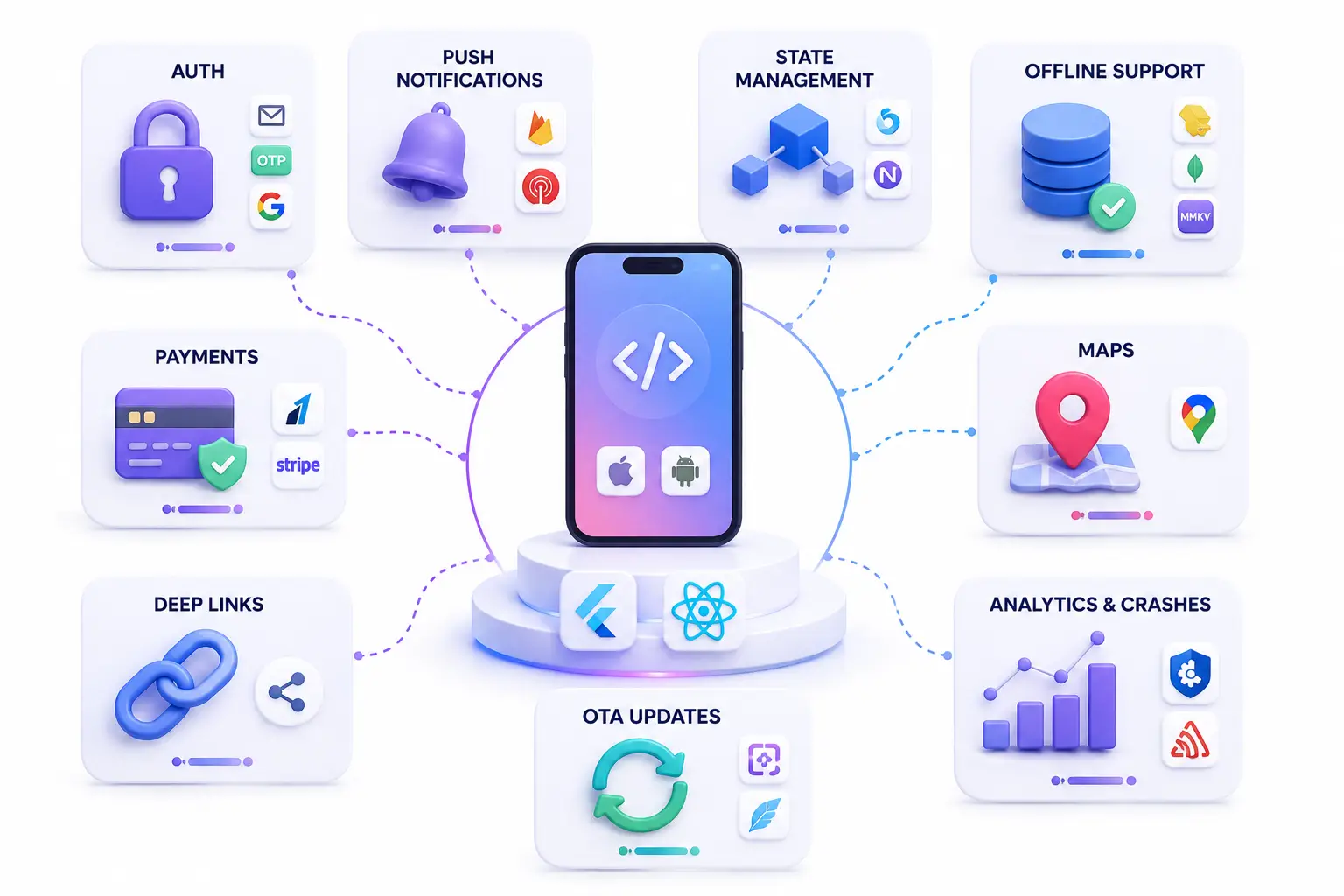
Cross-Platform Features We Implement
- Authentication — Email, OTP, and social login with secure token storage
- Push Notifications — FCM and APNs, delivered via Firebase or OneSignal
- State Management — Bloc or Riverpod for Flutter; Redux or Zustand for React Native
- Offline Support — Local storage using Hive, SQLite, or MMKV for read-heavy data
- Payments — Razorpay and Stripe SDKs, or WebView-based checkout
- Deep Linking — For marketing campaigns and shared content (e.g., itineraries)
- Maps — Google Maps integration, scoped to project needs
- Analytics & Crash Reporting — Firebase Crashlytics and Sentry
- OTA Updates — CodePush or Shorebird for shipping JavaScript hotfixes without a full store release
Backend + Cross-Platform Mobile
We build the API layer and the mobile app together, so validation logic, authentication, and business rules stay consistent across web and mobile:
- 1.Client — Flutter or React Native app (iOS + Android)
- 2.API — Laravel or Node.js
- 3.Database — PostgreSQL on RDS
This shared-backend approach is how most of our travel and SaaS clients launch on both app stores without doubling their engineering effort — with MVP timelines typically in the 10–12 week range, depending on scope.
Launch on both stores without doubling engineering effort — with MVP timelines typically in the 10–12 week range, depending on scope.
Why Work with Teenva AI on Cross-Platform Development
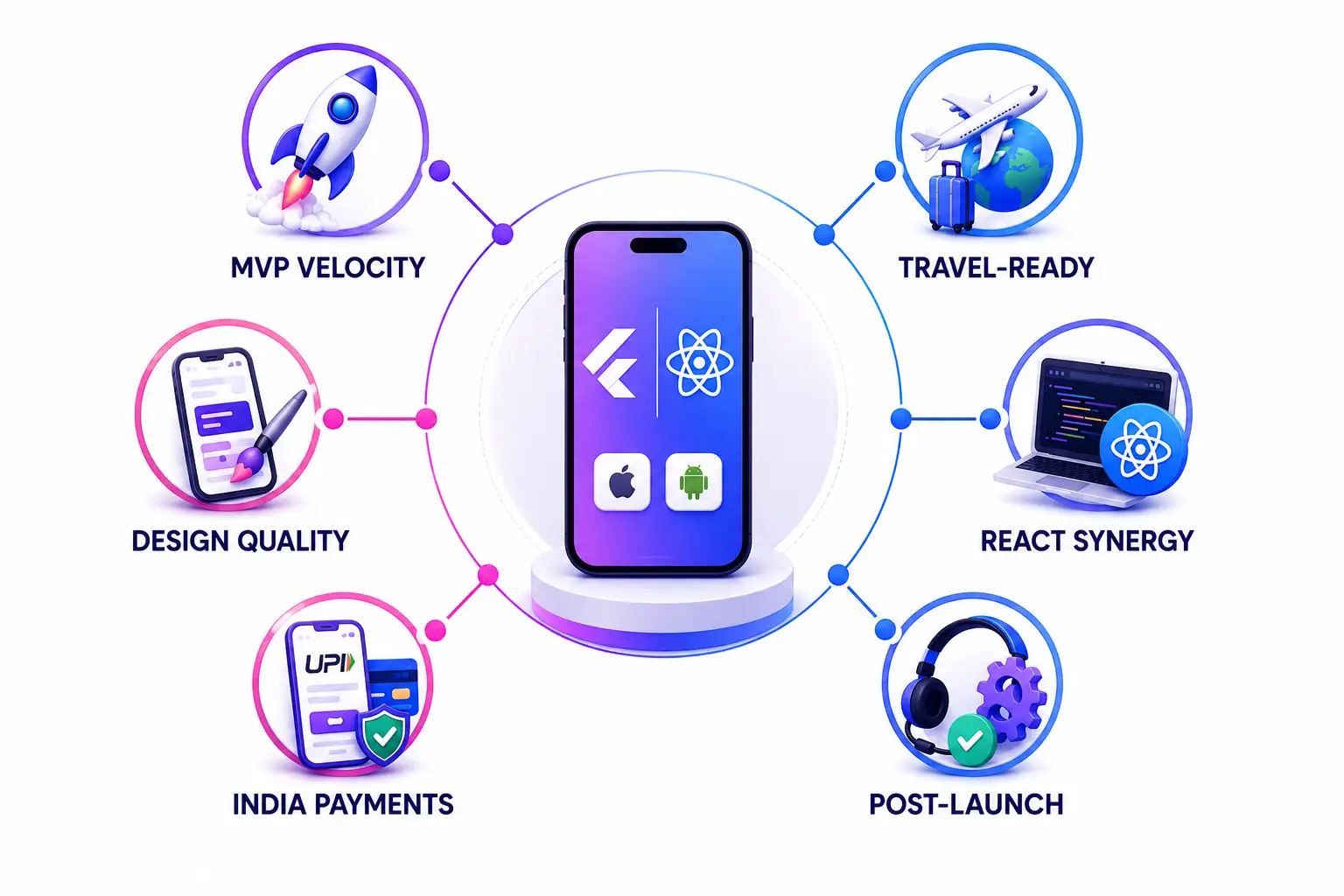
MVP Velocity
One team, both app stores, shared CI/CD pipelineTravel-Ready
Booking flows built to connect with real GDS and bedbank backends via travel technologyDesign Quality
Mobile UI/UX design happens before development sprints beginReact Synergy
React Native pairs naturally with existing Next.js web productsIndia-Ready Payments
UPI and international card support via established gateway SDKsPost-Launch Support
Managed IT support for OS updates and app store compliance
Our Cross-Platform Development Process
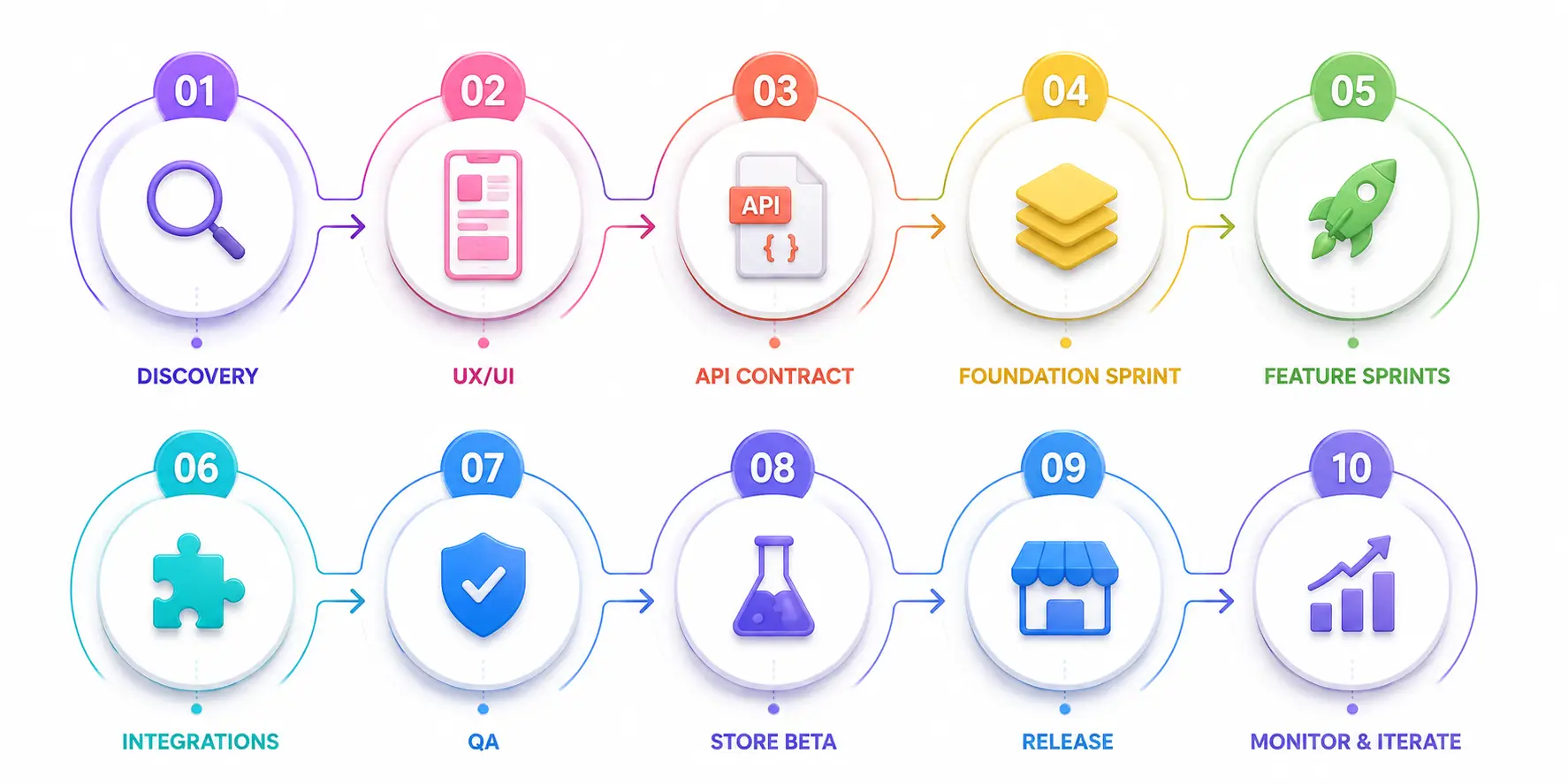
Discovery
Decide between Flutter and React Native, define the feature list, assess backend readiness
UX/UI Design
Map user flows and build a component library
API Contract
Define an OpenAPI specification with your backend team
Foundation Sprint
Set up authentication, navigation, theming, and environment configs
Feature Sprints
Build core product loops, demoed on a biweekly cadence
Integrations
Add push notifications, payments, maps, and other scoped integrations
QA
Test across an iOS and Android device matrix
Store Beta
Distribute via TestFlight and the Play internal testing track
Release
Support with store listing preparation (scoped)
Monitor & Iterate
Track crashes and reviews, and plan the next phase of the roadmap
Performance & Quality Practices
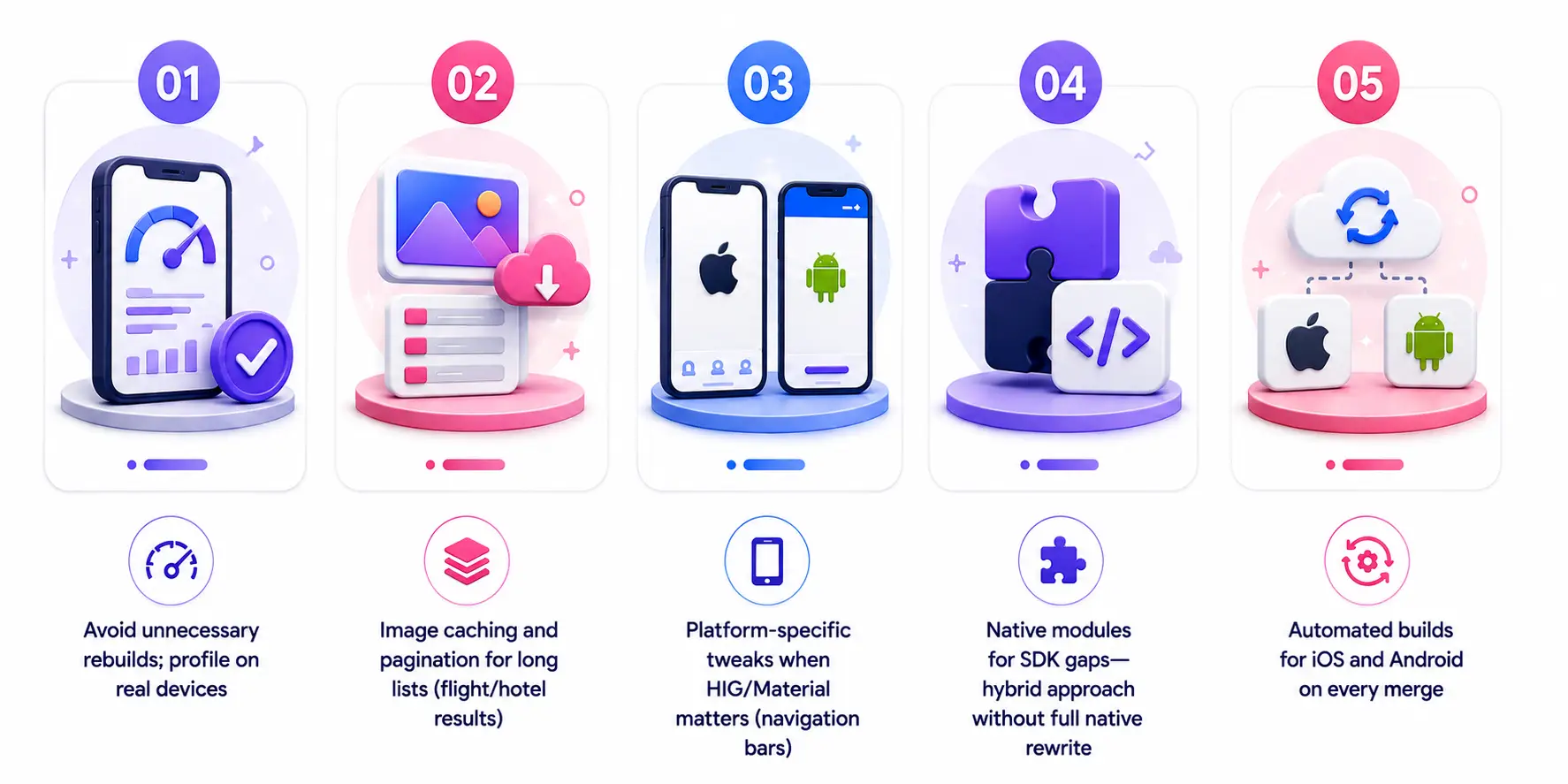
Avoid unnecessary re-renders/rebuilds; profile performance on real devices, not just simulators
Use image caching and pagination for long result lists (e.g., flight or hotel search results)
Apply platform-specific adjustments where Human Interface Guidelines or Material Design conventions matter, such as navigation bars
Use native modules to close SDK gaps — a hybrid approach rather than a full native rewrite
Run automated builds for both iOS and Android on every merge
When performance profiling surfaces real limits, we'll discuss whether native modules or selectively native screens make sense for your app. Native mobile app development.
Travel Apps on Flutter / React Native
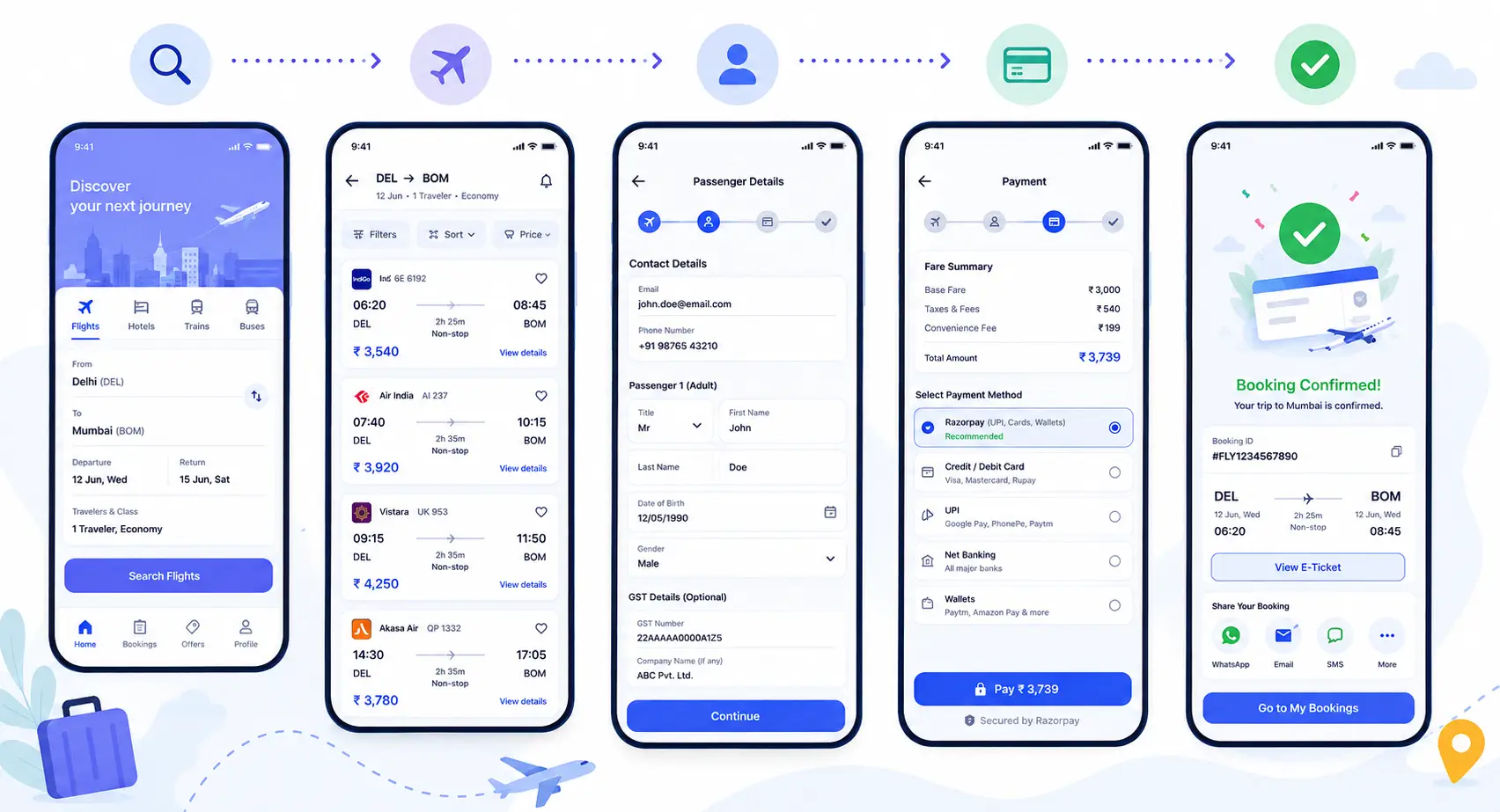
Cross-platform frameworks handle multi-step booking flows well:
- Search filters, sorting, and fare display
- Guest detail forms, including GST fields for India
- Payment via Razorpay or card
- Booking confirmation and sharing
The backend handles the complexity of travel API integrations, which keeps the mobile app itself lightweight and fast.
Frequently
Asked Questions
Straight answers about our services, how we work, and how to get started with Teenva.
Custom software, AI solutions, and travel technology — built for teams that need more than templates.
We generally recommend Flutter when UI consistency and development speed matter most, and React Native when your team already works in React. The right choice depends on your specific product and team, which we'll confirm during discovery.
Yes, for the large majority of the app. Platform-specific code is used selectively — for example, to follow iOS and Android navigation conventions or to access certain native device features.
Yes. We assess your current app's architecture and feature set during discovery and scope a migration plan accordingly.
Most of our travel and SaaS clients launch an MVP in roughly 10–12 weeks, depending on feature scope and backend complexity.
Yes, this is a scoped part of our process, including TestFlight and Play Store internal testing tracks ahead of release.
Related Services
Launch on iOS & Android Together
Flutter and React Native MVPs with shared APIs — for travel, SaaS, ecommerce, and B2B clients, delivered from Bangalore to businesses worldwide.
Let's Start a Conversation
Ready to take your business to the next level?